Personalized Medical Care & Dedicated International Patient Concierge

Press Release
Can Implants Be a Way to Save Natural Teeth?
Dental implants can help save natural teeth by restoring lost chewing balance and preventing damage to remaining teeth. Learn when early implant treatment truly protects your smile.
Schedule a Consultation

Dental implants are an effective treatment for restoring the function of lost teeth, and they are not only widely used in modern dentistry but also highly recognized by patients visiting dental clinics. However, it is also true that implants are perceived as synonymous with overtreatment, as some commercially driven dental clinics induce patients to undergo implant surgery after extracting teeth, even when natural teeth could be sufficiently treated and preserved.
The fundamental goal of dental treatment is to maintain the health of teeth for a long period. Unless extraction is absolutely necessary, teeth must be used through root canal treatment and prosthetic treatment.
However, there are teeth that are difficult to save even with these treatment methods; in such cases, it is important to boldly extract the tooth and restore the lost tooth tissue early in order to preserve other teeth. Paradoxically, choosing an implant early can effectively save other teeth.
When a tooth is lost, the remaining teeth bear the entire chewing force. For example, if the chewing force is considered 100 and 10 teeth each receive 10 units, losing two teeth results in 12.5 units of force being applied to each of the remaining eight teeth. Therefore, as the number of lost teeth increases, the remaining teeth bear increasingly greater force, which can damage other teeth as well. This process is quite common, particularly in cases where patients delay dental treatment until many teeth are extracted. To help understand why this happens, I intend to explain using cases observed over several years.
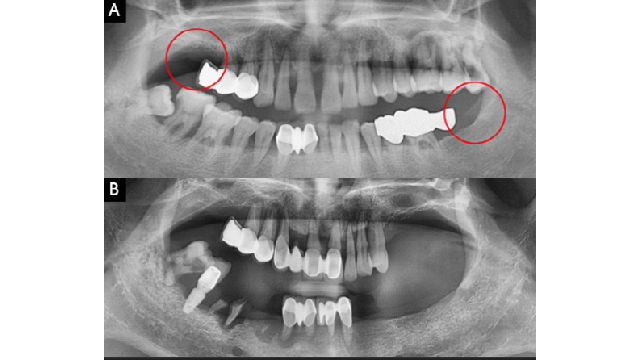
A is a photo of patient Kim OO, who was 44 years old in 2009, and B is a photo of the patient 10 years after his first visit.
Looking at the red circle in Photo A above, a total of three teeth are missing, including the upper right molar and the lower left molar. Although there is overall gum disease, the patient refused implants and gum treatment for the missing teeth, believing that there were many remaining teeth.
Exactly one year later, when the patient visited with a missing left molar, they had been eating only on the left side because chewing on the right side was uncomfortable, and eventually, one molar had fallen out, unable to withstand the strain. At this time, we recommended prosthetic treatment, so the front teeth and molars were treated with a bridge, and the patient wanted the other teeth treated later.
This patient visited the dental clinic again two years later, and it was observed that the overall amount of gum bone had decreased and the condition of the remaining teeth was gradually deteriorating, such as the lower left molar falling out naturally.
Advertisement
Four years later, an implant was placed on one tooth, but because the implant treatment for the missing molar was not properly performed, the condition of the remaining tooth was also gradually deteriorating. Furthermore, Photograph B, taken 10 years after the first visit, shows that multiple teeth were lost due to the missing molar not being properly treated. Ultimately, the situation reached a point where full-body implants were required.
The meaning of the above case is clear. In this patient's case, more than 20 teeth were extracted over the 10 years following the first visit. This is because the appropriate timing for treatment was missed.
To elaborate, teeth receive force from the masticatory muscles attached to the mouth when chewing food. This occlusal force acts on the teeth constantly when chewing, swallowing saliva, and even during sleep. If you have ever had your finger bitten, you can likely gauge the intensity of this occlusal force. Physiologically, teeth and surrounding gum tissues are designed to effectively receive and distribute this force acting throughout a lifetime, and they also possess protective mechanisms to defend against excessive occlusal force. However, if a missing tooth is left untreated, the masticatory force acts on the tooth incorrectly (such as eating only on one side or chewing with the front teeth), and these bad habits cause significant damage to other teeth and gums.
For this reason, as a dentist, I feel a great sense of regret regarding the case of the patient above, as it suggests that if gum treatment or a small number of implants had been performed initially, the need for full implants might not have arisen.
In actual dental practice, there is a prevailing sentiment that recommending implants to patients is an unnecessary procedure. However, most conscientious dentists understand that it is better to extract severely damaged teeth and create replacements for the missing ones, if only to protect the rest of the teeth. Patients need to understand and cooperate, recognizing that this is not merely a process of creating missing teeth, but a method that helps ensure the remaining teeth can be used effectively for a lifetime.
Therefore, if you believe you need an implant, rather than avoiding treatment out of suspicion of overtreatment, it would be a wise course of action to promptly visit a dental clinic where specialists in Conservative Dentistry and Periodontology collaborate to identify teeth that truly require implants, and where an accurate implant plan can be established under the guidance of a Prosthodontist if necessary. This approach will help reduce both the cost and the discomfort associated with implants. [Advice provided by Dr. Park Hyo-jin, Director of Magok Pureunmaeum Dental Clinic near Balsan Station in Magok-dong, Gangseo-gu (Specialist in Conservative Dentistry)]