Personalized Medical Care & Dedicated International Patient Concierge

Medical Guide
Dental Implant Brands Comparison: Questions to Ask First
A dental implant brands comparison cannot be settled from a brochure. Compare two systems on documentation, regulatory listing, design rationale and parts.
Schedule a ConsultationChoosing Between Two Dental Implant Brands or Systems: Questions to Ask Before You Decide
Medically reviewed by Dr. Park Kyung Ran, Specialist in Oral and Maxillofacial Surgery
A dental implant brands comparison cannot be settled from a brochure, because no published body of evidence ranks one manufacturer above another for long-term success. What you can compare is how well each proposal is documented, how the design choice is explained, and whether the parts will still be obtainable years from now. That last point matters most if you are treated in one country and live in another. This article gives you a vendor-neutral checklist of questions, and it deliberately names no brands.
Why "Which Brand Is Better?" Is the Wrong First Question
The comparison you are being asked to make is one that clinical research has not resolved. A Cochrane systematic review of different types of dental implants pooled 27 randomized controlled trials and compared 38 implant types that varied in surface characteristics, shape, degree of titanium purity, and titanium alloy. Its conclusion was that there was no evidence showing any particular type of dental implant has superior long-term success over another. The authors did report one limited finding: implants with relatively smooth, turned surfaces appeared less prone to losing bone from chronic infection than implants with much rougher, titanium-plasma-sprayed surfaces. They immediately qualified it, noting the trials were often at high risk of bias, involved few participants, and had short follow-up.
Read that carefully, because it cuts in two directions. It does not mean every system suits every clinical situation. It means the difference between two reputable systems is unlikely to decide whether your implant lasts, while the things you can verify — diagnosis, surgical planning, component fit, hygiene, and follow-up — carry more weight. Marketing claims also deserve skepticism whoever makes them, since a survival figure from a company-sponsored study is not the same kind of information as an independent head-to-head trial.
So the useful question is not "which brand wins." It is: "what am I actually being given, can I verify it, and who can look after it later?"
What an "Implant System" Actually Includes
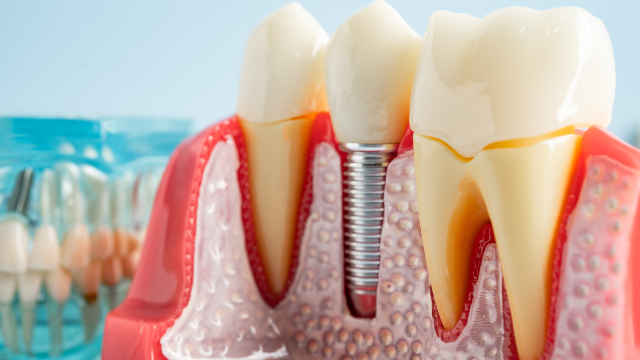
A brand name refers to an entire catalog of matched parts, not to a single screw in your jaw. Knowing the parts list turns a vague brand debate into answerable questions.
- The fixture — the threaded post placed in bone, defined by diameter, length, thread pattern, and surface treatment.
- The connection — the internal or external geometry at the top of the fixture that everything else attaches to.
- Abutments — the connecting pieces between fixture and crown, either stock components or individually milled ones.
- Prosthetic screws — small titanium screws that hold the assembly together and are the part most likely to need replacement.
- The surgical instrument set — the drills and torque drivers specific to that system.
- Impression and scanning components — the parts a laboratory needs to reproduce your implant position accurately.
- The digital library — the design files a dental laboratory loads to mill a matching restoration.
The regulatory picture reflects this. The US Food and Drug Administration classifies root-form endosseous dental implants as Class II devices subject to special controls, and its guidance describes four geometrically distinct root-form types: basket, screw, solid cylinder, and hollow cylinder. Abutments are regulated alongside the implants they attach to. Two treatment plans may differ far less in the fixture than in everything designed to connect to it.
Question 1: What Exactly Will Be Placed, and Will I Get It in Writing?
Ask for the manufacturer, the system name, the reference or catalog number, the diameter and length, and the lot or serial number — in writing, both before surgery and after it. The FDA's own patient guidance tells you to ask your dental provider about the brand and model of the implant used and to keep that information for your records. It is the most portable thing you can take home.
There is a formal identification scheme behind this. Under the FDA's unique device identification system, device labelers must include a unique device identifier on device labels and packages, and in some cases on the device itself, in both human-readable and machine-readable form. The information filed against it sits in the Global Unique Device Identification Database, which anyone can search through the AccessGUDID portal maintained with the National Library of Medicine. Searchable fields include the device identifier, the device name, the company name, the magnetic resonance safety status, and the premarket submission number.
Practical steps for the day of surgery:
- Ask whether the peel-off label from the implant package will be placed in your chart, and request a copy or a photograph of it.
- Ask for a post-operative radiograph, which gives a second, independent record of what is in your jaw.
- Ask for the same details for the abutment and the crown, not only the fixture.
- Ask for the records in a language you read. Magok Pureunmaeum Dental Clinic's documentation states that translated documents are available.
None of these requests should be awkward, because a clinic that plans carefully already has the information written down.
Question 2: Where Is the System Registered, and Can I Check That Myself?
A device sold legally in Korea has been through Korea's Ministry of Food and Drug Safety, the national authority for medical devices there — which is not the same as being cleared for the US market. If you are treated abroad and expect follow-up care at home, both questions are worth asking.
In the United States, most dental implants reach the market through the 510(k) premarket notification pathway. The manufacturer must obtain a substantial equivalence determination from the FDA before marketing, showing the device meets the recommendations of the special controls guidance or otherwise provides equivalent assurances of safety and effectiveness. Be precise about what that means: clearance is a market-entry decision based on comparison with an existing legally marketed device, not a quality ranking, an endorsement, or a statement that one system outperforms another.
What you can do with this:
- Ask whether the proposed system is also marketed in the United States, and under which company name.
- Search that company name in AccessGUDID to see what is listed and what the premarket submission number is.
- Treat a loose verbal claim of approval as an invitation to ask for the specific clearance or registration reference.
- Note the magnetic resonance safety status while you are there, since the FDA advises telling imaging technicians about implants before an MRI or X-ray.
Question 3: What Does the Published Evidence for This System Look Like?
Ask how long the system has been sold in its current form and what independent follow-up has been published on it. A recently redesigned system — a new surface, a changed connection, a different alloy — carries a shorter clinical record than its brand name suggests, because the older studies describe a different device.
Reasonable follow-up questions:
- How many years has this exact fixture design and surface been on the market?
- Has the connection platform changed within the last few product generations?
- Is there published follow-up beyond studies funded by the manufacturer?
- How many of these has this clinic placed, and over what period?
Be fair about the limits here. Because comparisons between implant types rest on relatively few trials, a thin published record is not proof a system is inferior, and a thick one is not proof it will suit your anatomy. What these answers really test is whether the dentist knows the product well enough to describe its history without a sales sheet.
Question 4: What Connection and Surface Does the System Use, and Why That One?
Two design features are specific enough to ask about without refereeing engineering: the implant-abutment connection and the fixture surface.
The connection is the junction between the part in your bone and the part in your mouth. Systems use external connections, internal flat-to-flat connections, or internal conical designs. A systematic review and meta-analysis in Clinical Implant Dentistry and Related Research examined the influence of connection type on peri-implant bone loss and reported that crestal bone levels were better maintained in the short to medium term with internal interfaces, with conical connections performing favorably against external hexagonal ones. The proposed mechanism is a smaller micro-gap at the junction and less micro-movement under chewing load. Framed honestly, this is one variable among many, and connection design does not override bone quality, hygiene, or surgical placement.
The connection matters for a second, more practical reason: it determines which abutments and screws fit. A dentist elsewhere cannot repair the implant with the wrong platform, whatever the brand on the box.
Surface treatment is the other axis. Most contemporary fixtures use a moderately roughened surface intended to encourage bone to grow against it, rather than the smooth machined surfaces of earlier generations. Cochrane's cautious finding about rougher surfaces belongs in the conversation, but so does the small size of the trials behind it. The useful question is not "is rough better than smooth," but "why this surface for my bone quality?"
Question 5: Will the Components Still Be Available Years From Now?
An implant is a long-term device whose future repairs depend on small manufactured parts, and this is the question patients most often skip.
Consider routine maintenance over a lifetime. A prosthetic screw can loosen or fracture and needs an exact replacement. A crown may need remaking, which requires matching laboratory components. An abutment may need changing if gum contours alter. Every one of those repairs depends on knowing which system is in the bone and being able to buy parts for it.
That knowledge is easily lost. Research teams have been developing automated methods to identify dental implants from radiographs because clinicians so often face an implant of unknown origin and must work from photographs, radiographs, and models. Compatible impression and restorative components depend on matching the implant exactly, so an unidentified system turns a simple repair into an investigation.
Questions worth asking before you agree to anything:
- Is this system still actively manufactured and marketed, or is it an older line?
- Does the manufacturer have a distributor or subsidiary in the United States?
- If a prosthetic screw fractures in five years, where would the replacement come from?
- Are third-party "compatible" components available for this platform, and does the clinic recommend them?
On that last point, aftermarket components made by a company other than the fixture manufacturer exist for many platforms. They can be convenient. They can also change how precisely the parts seat together, and mixing manufacturers may affect the terms of any coverage offered on the original components.
Question 6: Who Could Service This System Where You Live?
Before you travel, find out whether a dentist near your home can restore, adjust, or repair the system being proposed. This is the part of an implant plan that international patients can only arrange in advance, while you still have the option of choosing differently.
A workable sequence:
- Ask your dentist at home whether they work with the system, or can order components for it, before you commit to treatment abroad.
- Ask the treating clinic which records you will leave with, including the implant identification and post-operative imaging.
- Ask who would handle a revision, where it would be performed, and what the sequence would be.
- Ask directly what follow-up support is available after you return home rather than assuming any particular arrangement.
The Centers for Disease Control and Prevention's Yellow Book is blunt about the general case. Dental care is the most common form of medical tourism among US travelers, and its guidance is to obtain copies of all medical records from the facility abroad before returning home, translated into English where needed, and to agree in advance on a plan for handling complications. For implants, the record that matters most identifies the system.
Magok Pureunmaeum Dental Clinic states that multilingual support is available across its patient services, with interpreter arrangements determined after consultation, and that translated documents are available. Its documentation does not settle what remote aftercare looks like once you are back in the United States, so treat that as an open question to raise on the contact page rather than an assumption to carry into surgery.
A Side-by-Side Framework for Comparing Two Proposals
Put the two recommendations side by side and score them on what is verifiable rather than on reputation.
| What to compare | Why it matters | A strong answer | A weak answer |
|---|---|---|---|
| Written identification | Every future repair depends on this record | Manufacturer, system, reference number, dimensions, and lot number, in writing | "We use a premium implant" |
| Regulatory listing | Shows where the device is legally marketed | Names the regulator and a reference you can check | A general claim of approval |
| Published record | Shows the design has follow-up, not just a new name | Explains how long this design has been unchanged | Quotes a brochure figure |
| Design rationale | Tests whether the choice fits your anatomy | Links connection and surface to your scan | "This is what we always use" |
| Abutment plan | Fit at the gum line affects cleaning | States stock or individually milled, and why | Leaves the component undecided |
| Parts availability | Repairs need matching components later | Confirms the line is current and how parts reach you | Has not considered it |
| Coverage terms | Conditions and exclusions vary | Provides written terms and conditions | Describes coverage verbally |
| Who operates | Surgical experience is not a catalog feature | Names the dentist and their training | Leaves the operator unnamed |
When the Less Familiar System Is the Right Choice for You
A comparison that always concludes in favor of the bigger name is not a comparison. There are real situations in which the less globally famous system is the better decision.
- Your home dentist already works with it. Serviceability where you live can outweigh a marginal difference in catalog specifications, especially for a patient flying home eight time zones away.
- Your anatomy needs a specific component. Narrow spaces, angled emergence, and limited bone height sometimes call for a diameter, length, or angled part that only one catalog offers.
- The surgeon has far more experience with it. Placement accuracy and case selection are operator variables, and a dentist who knows one system deeply is not obviously worse than one using an unfamiliar premium line.
- The prosthetic workflow is proven locally. If the dental laboratory and the digital library are established near you, the restoration is easier to make and to remake.
- The evidence gap runs both ways. Since pooled trial data do not establish superiority for any one type, weighing logistics over reputation is a defensible reading of the research.
The reverse also holds. A fixture with an excellent laboratory record that nobody near your home can service carries a real cost, and that cost belongs in the comparison rather than in a surprise years later.
What This Clinic Documents About Its Implant Work
Magok Pureunmaeum Dental Clinic's published documentation describes its implant protocol rather than a preferred manufacturer, so the system in your own plan is a question to ask at consultation.
Its diagnostic workflow begins with a standard panoramic X-ray alongside a 3D-CT scan, used to evaluate jawbone density, nerve pathways, blood vessels, and the roots of neighboring teeth. Cone beam computed tomography is publicly listed as available at the clinic, with one unit. On the prosthetic side, the clinic documents custom-milled anatomical abutments shaped to each patient's gum contour, with a specific rationale: standard non-customized components can leave small gaps that trap food particles or residual dental cement, which it links to gum inflammation and reduced durability. That is the kind of component-level detail worth seeking from any clinic.
Two further points sit in its records. The clinic combines periodontal treatment with implant therapy to support long-term stability, and requires necessary gum treatment before placement. Its aftercare protocol asks patients to attend regular follow-up checkups, maintain hygiene that prevents food impaction, and seek prompt evaluation for pain, looseness, or gum disease.
The clinic also operates a structured warranty program covering implant fixtures and crowns, with benefits contingent on keeping regular dental checkups. Coverage details and exclusions should never be taken from an article, so ask for the current written terms before treatment begins.
Implant surgery falls to Dr. Park Kyung Ran, a Specialist in Oral and Maxillofacial Surgery who graduated from Yonsei University College of Dentistry and completed internship and residency training in the Department of Oral and Maxillofacial Surgery at Yonsei University Dental Hospital, followed by Master's and Doctoral programs in the same field. She is a licensed dentist in South Korea and a Senior Board-Certified Member of the Korean Association of Maxillofacial Plastic and Reconstructive Surgeons. These are Korean specialist credentials and are not equivalent to US board certification.
The practice was established in 2017 in Gangseo-gu, Seoul, and reports more than 10,000 procedures across its Minish and implant work combined. It is a Registered Medical Institution for Attracting Foreign Patients certified by Korea's Ministry of Health and Welfare under the Medical Overseas Expansion and Foreign Patients Attraction Act — a Korean government registration permitting treatment of international patients, not a clinical quality accreditation. Background on both dentists is on the clinic's about page. Notably, "Can I get a second opinion on an implant recommendation?" appears on its own documented list of questions to expect from US patients.
The Bottom Line
- Pooled trial evidence does not show that any implant type has superior long-term success, so choosing between two reputable systems is not what determines your outcome.
- Ask for the manufacturer, system name, reference number, dimensions, and lot number in writing; the FDA advises keeping the brand and model of your implant in your own records.
- Connection geometry decides which parts fit, so it governs whether a dentist elsewhere can repair the restoration later.
- Parts availability and local serviceability are the questions international patients most often skip; ask them before treatment, not after a screw fractures.
- Ask for warranty terms in writing, and settle remote follow-up with the clinic before you fly home.
Frequently Asked Questions
If one system is more expensive, is it better?
Price differences reflect manufacturing, distribution, and marketing as much as clinical performance, and pooled research has not shown that any one implant type outperforms another over the long term. A costlier component can still be right if it is the one your anatomy or your home dentist requires. Ask what the difference buys in your case, and ask for the answer in terms of your scan.
My dentist will not name the system until the day of surgery. Is that normal?
Planning an implant requires selecting a diameter, length, and platform in advance, so the information generally exists well before you sit in the chair. It is reasonable to ask for it during planning and to have it confirmed in writing afterward. The FDA advises patients to obtain the brand and model of the implant used, which is hard to do if the choice is treated as a detail only the clinic needs.
Are third-party or "compatible" abutments a problem?
They are widely available for common platforms and are not inherently unsafe, but they are made by a different company from the fixture. That can affect how precisely the parts seat together, and mixing manufacturers may change what any coverage on the original components includes. Ask which components will be used, who makes each one, and how that choice affects the terms you were quoted.
Do implant systems differ in the material they are made from?
Yes, in ways that are usually modest. The Cochrane review compared implant types differing in shape, surface characteristics, degree of titanium purity, and alloy composition, and still found no evidence of superior long-term success for any one type. Some systems also offer ceramic fixtures rather than titanium. Ask what your fixture is made from and why that material suits your site.
What records should I ask to bring home after implant surgery?
Ask for the implant identification details, the surgical report, post-operative radiographs, and any laboratory documentation for the abutment and crown. The CDC advises people receiving care abroad to obtain copies of all records before returning home, translated into English where necessary. Magok Pureunmaeum Dental Clinic's documentation states translated documents are available, so it is a fair request to make in advance.
Two dentists recommended different systems. Does that mean one of them is wrong?
Not necessarily, and often not. Dentists tend to use the systems they trained on, hold instrument sets for, and have restored many times, and that familiarity is a genuine clinical advantage. The difference becomes a problem only if one recommendation cannot be documented, cannot be serviced near your home, or cannot be explained in terms of your own imaging.
This article is for general informational purposes and does not constitute individualized medical advice, and it is not a self-diagnosis tool. Treatment candidacy, technique, and expected outcomes can only be determined through a consultation with a qualified dentist.
More Articles
Continue reading our clinical guides.

Cavity Treatment Korea: Resin Filling vs Inlay or Crown
A resin restoration is usually enough when decay is small and the tooth's walls and cusps are intact. Larger damage points to an inlay, onlay, or crown.
Learn More

Inlay Onlay Dental Restoration vs Crown: How to Choose
An inlay or onlay restores a damaged tooth without full coverage. Published data show partial-coverage survival close to crowns, so choose by tooth left.
Learn More

Minish Dental Treatment: How It Preserves Tooth Structure
Minish dental treatment is a biomimetic restoration that rebuilds damaged teeth with precision-made blocks while removing as little enamel as possible.
Learn More